
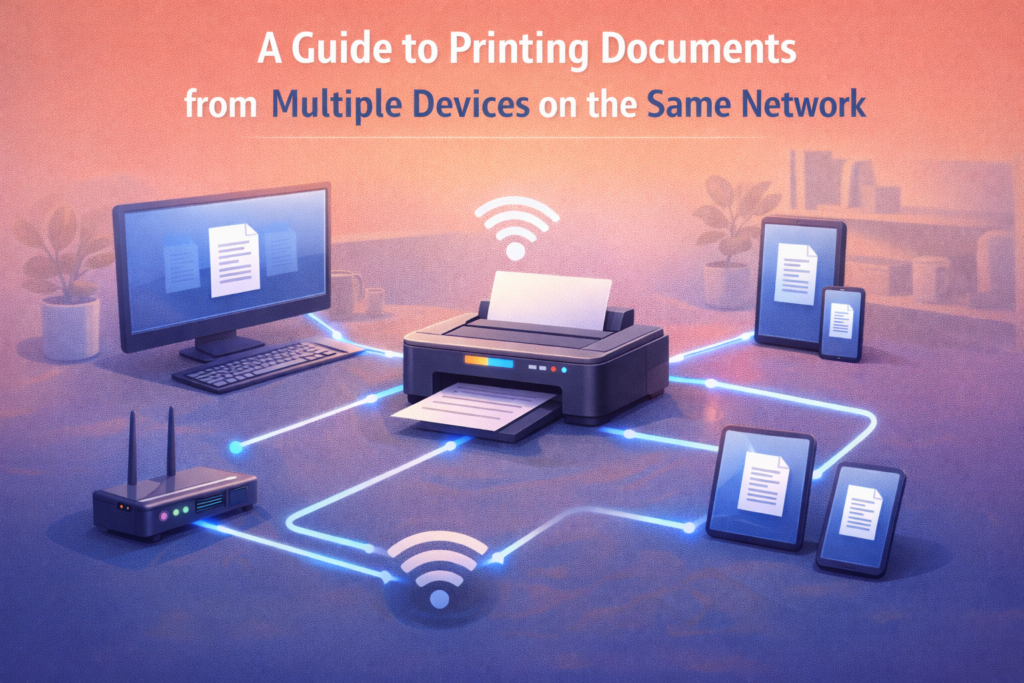
A Guide to Printing Documents from Multiple Devices on the Same Network
(General Educational Guide)
Printing documents from multiple devices on a shared network has become a common scenario in homes, offices, and educational environments. Understanding how wireless printers interact with several devices helps users organize printing tasks efficiently and avoid temporary visibility or access delays.
This guide explains general principles behind multi-device printing. The exact experience may vary depending on printer type, operating system, and network environment.
This content is provided solely for educational and informational purposes.
What Is Multi-Device Printing on a Shared Network?
Multi-device printing refers to the ability of a single printer to receive and process print jobs from multiple computers, smartphones, or tablets connected to the same network.
This process typically relies on:
Network connectivity for all devices
Device discovery protocols
Printer memory and queue management
Operating system compatibility for each connected device
If any of these elements are unavailable or restricted, some devices may temporarily fail to detect the printer.
Items Commonly Needed for Multi-Device Printing
A Wi-Fi-enabled printer powered on and connected to the network
Multiple devices (computers, smartphones, tablets) connected to the same network
Network name and password
Awareness of network layout and signal coverage
These items are commonly referenced in educational discussions of shared printer usage.
General Steps Commonly Observed During Multi-Device Printing
1. Device Discovery
Each device uses built-in network discovery protocols to locate the printer. Visibility may vary depending on:
Network signal strength
Device operating system settings
Printer readiness
2. Printer Queue Management
Printers typically organize incoming print jobs in a queue. When multiple devices send data simultaneously, the printer manages jobs in sequence, ensuring accurate printing.
3. Data Transfer
Each device transmits its document or image data to the printer over the network. The printer temporarily stores this data in memory before processing.
4. Job Completion
The printer processes each job in order, sending status information back to the originating device. Devices may display completion notifications once printing is finished.
5. Device Reconnection
After completing print jobs, devices continue to maintain network communication with the printer for future tasks. Visibility may briefly fluctuate if the printer enters low-activity or standby modes.
General Usage Considerations
Network stability is critical when multiple devices are connected
Large documents may require longer processing time, affecting job sequencing
Printers may temporarily prioritize jobs based on memory availability and document size
Devices using the same network may experience short delays in detecting the printer if multiple jobs are active
Regular printer use supports smoother operation in multi-device environments
Informational Notice
guidetoinstallation.info provides independent educational content on shared printer usage and network concepts.
Not affiliated with any printer manufacturer
No paid or technical services offered
Content does not replace official documentation